What is a Round Robin Calendar?
A Round Robin calendar shares bookings across your team. Guests book from one team page, and each booking goes to one team member, picked in turn. It’s built for sales demos, support calls, discovery calls, and any meeting where it doesn’t matter which person from your team takes it.
Guests don’t pick a host. Timetics AI hands each new booking to the next team member in line who’s free at that time. A time shows on your booking page as long as at least one host is free.
Why Use a Round Robin Calendar?
- Share the work fairly. Bookings rotate through your team in order, so nobody gets all of them.
- Offer more times. A time is open while any host is free, so guests get the combined availability of your whole team.
- Never double-book. Busy hosts are skipped automatically, and two guests booking the same time at once get different hosts.
- One link for the whole team. Share a single booking page instead of a link per person.
- Keep it fair when someone’s busy. A host who’s skipped because they’re busy keeps their turn and gets the next booking they’re free for.
Round Robin vs. Other Calendar Types
Timetics AI has a few calendar types that involve more than two people. Here’s how they differ:
| Who hosts | Who books a time | Best for | |
|---|---|---|---|
| One-to-One | You | One guest | Private meetings |
| One-to-Many | You | Many guests, one seat each | Classes, workshops, webinars |
| Many-to-One | Several team members together | One guest | Panel interviews, group consultations |
| Round Robin | One team member, picked in turn | One guest | Sharing bookings across a team |
Before You Start
Make sure of the following:
- Your plan includes team booking. Round Robin is a team booking calendar type. If your plan doesn’t include it, you’ll be asked to upgrade.
- Your team members have joined your workspace. You can only add people as hosts once they’ve accepted their invite. Invite them from Team first.
- Your hosts have connected their calendars (recommended). When each host connects Google, Outlook, or Apple Calendar, their personal events keep them from being assigned at those times, and their bookings land on their own calendar.
- Each host has connected their video tool, if you meet online. The Zoom or Google Meet link is created from the account of whoever gets the booking.
- A payment gateway is connected (only for paid meetings). If you plan to charge for the meeting, connect Stripe, PayPal, or another gateway under Integrations first.
How to Create a Round Robin Calendar
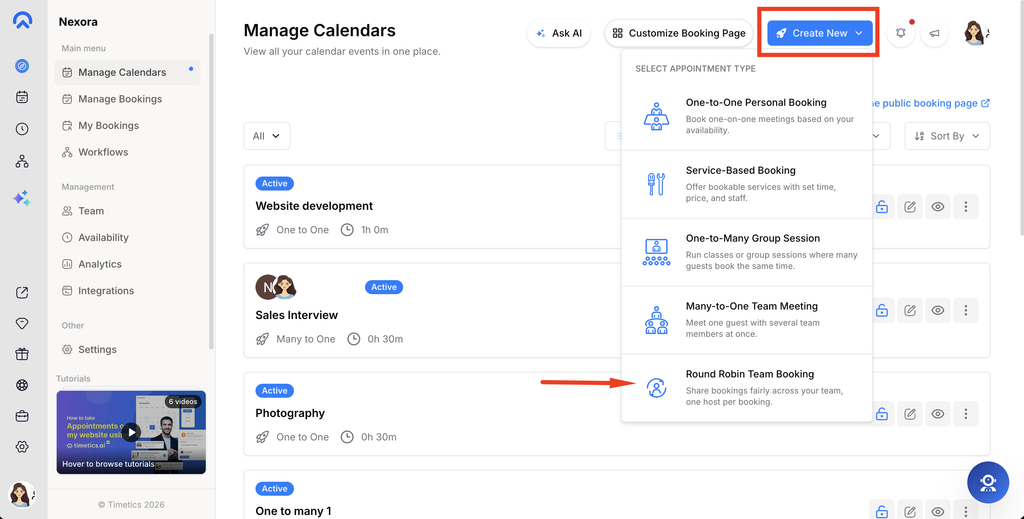
Step 1: Click Create New
Click Create New. Under Select Appointment Type, choose Round Robin Team Booking.
Step 2: Fill in the basics
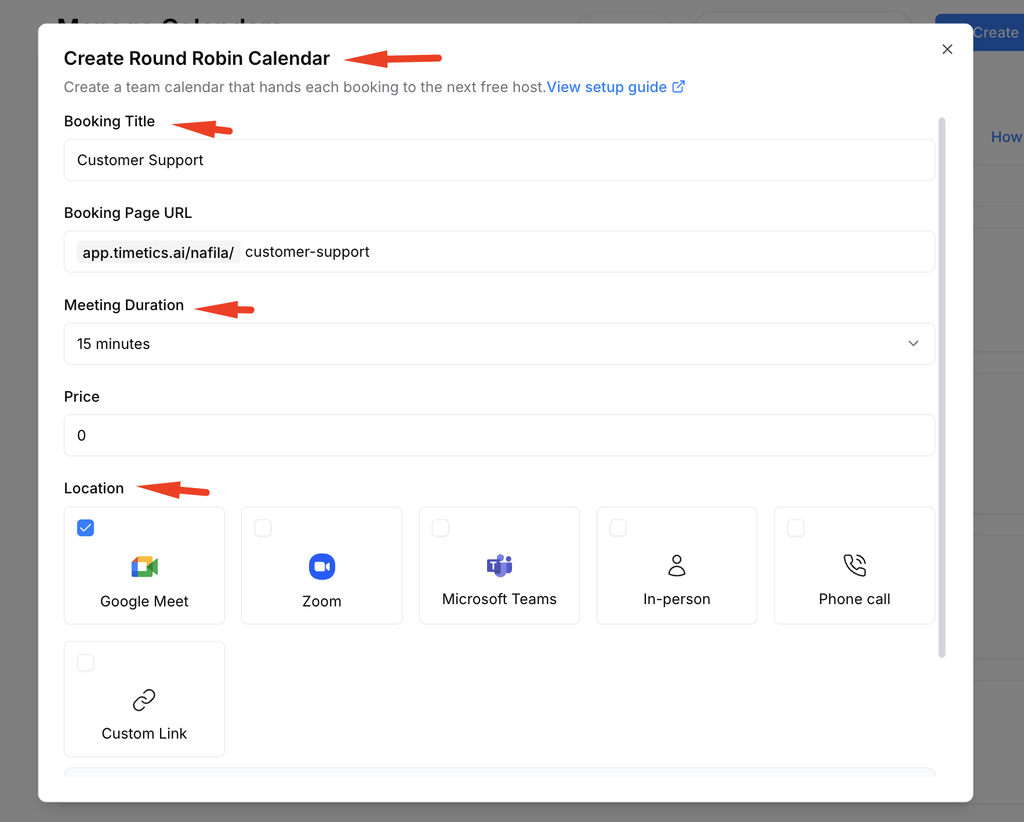
In the Create Round Robin Calendar window, fill in:
- Booking Title: The meeting name guests will see, like “Product Demo”.
- Meeting Duration: How long each meeting lasts.
- Booking Page URL: Filled in from your title. You can change it.
- Price: What the guest pays for the meeting. Leave it at 0 for a free meeting.
- Location: Where the meeting happens, like Zoom, Google Meet, or an in-person address.
Click Continue. Your calendar is created and its setup page opens.
Step 3: Add your team hosts
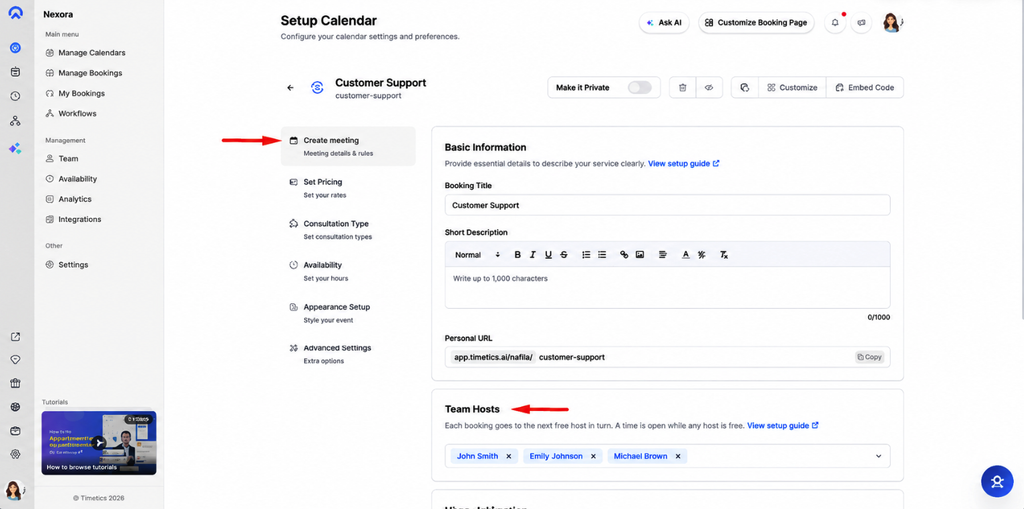
On the Create meeting tab, find the Team Hosts card. You’re already on the list as the first host.
- Click the field and pick the team members who should take turns.
- To take someone off, click the x next to their name.
Bookings rotate through hosts in the order you added them. You need at least 2 hosts, counting yourself. Until then you’ll see a red note under the field: Add at least 2 hosts. Until then this calendar takes no bookings. Your booking page won’t show any times while that note is there.
💡 Tip: Only add people who can take any of these meetings on their own. Guests can’t choose who they get, so every host should be ready to run the call.
Step 4: Finish the meeting details
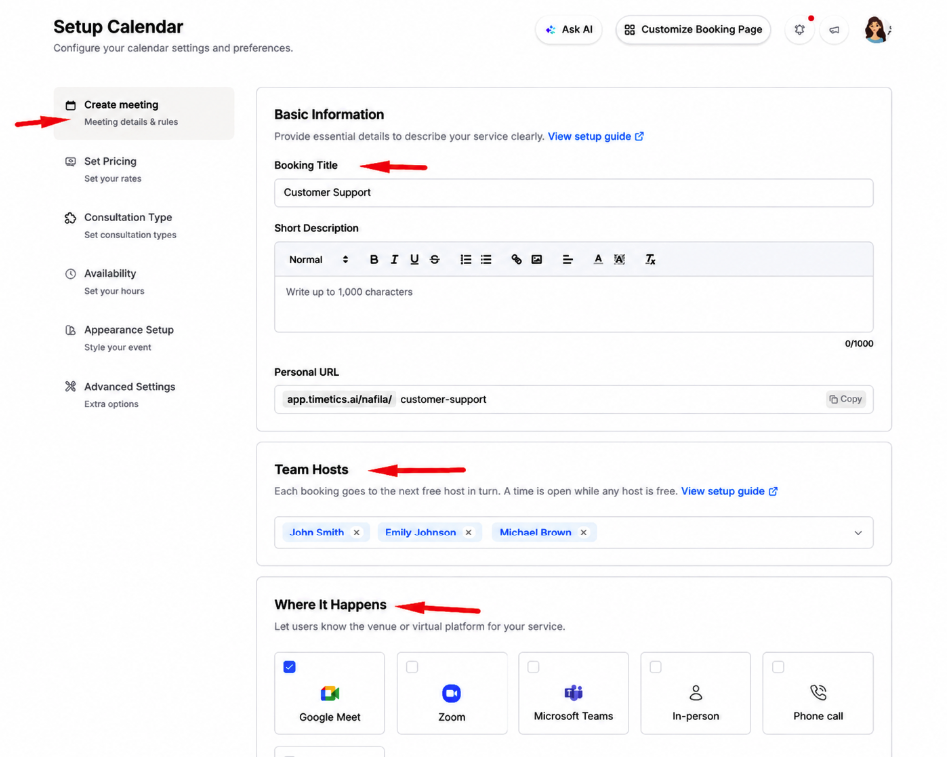
Still on the Create meeting tab, check the rest of the details:
- Basic Information: Your Booking Title, a Short Description of what the meeting covers, and your Personal URL.
- Where It Happens: Add or change the meeting location. For Zoom or Google Meet, the link is created from the assigned host’s own connected account.
Changes save on their own when you click away from a field.
Step 5: Set your meeting hours
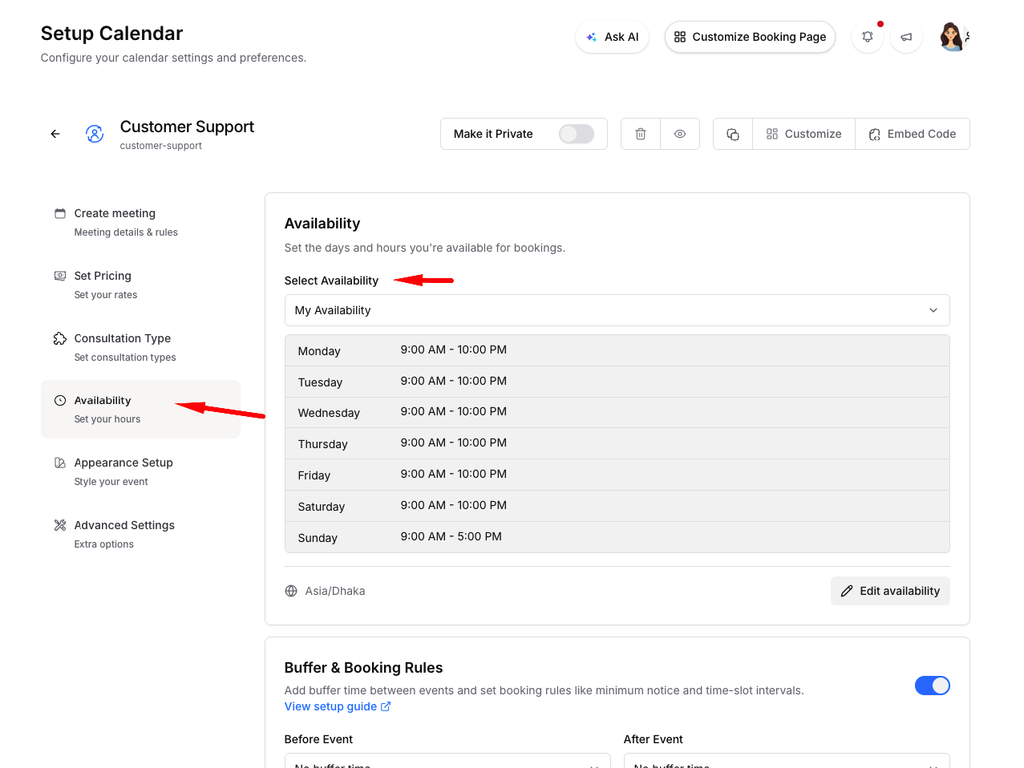
Open the Availability tab and set the days and hours you take meetings. These hours apply to every host on the calendar. Hosts don’t have separate working hours here.
Inside those hours, a time is offered as long as at least one host is free. If every host has another booking or a calendar event at that time, it’s hidden.
Step 6: Set pricing and other options (optional)
Use the other tabs the same way you would on any calendar:
- Set Pricing: The guest pays the same price no matter which host they get.
- Consultation Type, Appearance Setup, and Advanced Settings: Booking questions, approvals, reminders, look and feel, and the rest of your booking rules.
Step 7: Share your booking page
Your calendar is live as soon as it’s active and has at least 2 hosts. Copy the link from Personal URL and share it with your guests, or embed it on your website.
How Hosts Are Picked
Each new booking goes through your host list in order, starting with whoever’s turn it is:
- Timetics AI checks the host whose turn it is. If they’re free, they get the booking and the turn moves to the next person.
- If they’re busy at that time, they’re skipped and the next free host gets the booking.
- A skipped host keeps their place. They’re tried first for the next booking.
- If two guests book the same time at the same moment, they get different hosts. If nobody’s left, the second guest is asked to pick another time.
For example, with Alex, Sam, and Priya all free, bookings go Alex, Sam, Priya, then Alex again. If it’s Sam’s turn but Sam is busy, Priya gets it and Sam is still next in line.
What Your Guests See
- The guest opens your booking page. It shows your workspace name and logo, not a specific person.
- They see every date and time when at least one host is free.
- The guest picks a time, fills in the booking form, and pays if the meeting has a price.
- The confirmation screen and email show the name of the host they’ll meet.
What Happens After a Guest Books
- Only the assigned host is told. They get the new booking email and notification. The other hosts aren’t involved.
- The meeting lands on the assigned host’s calendar. If they’ve connected Google, Outlook, or Apple Calendar, the booking is added there.
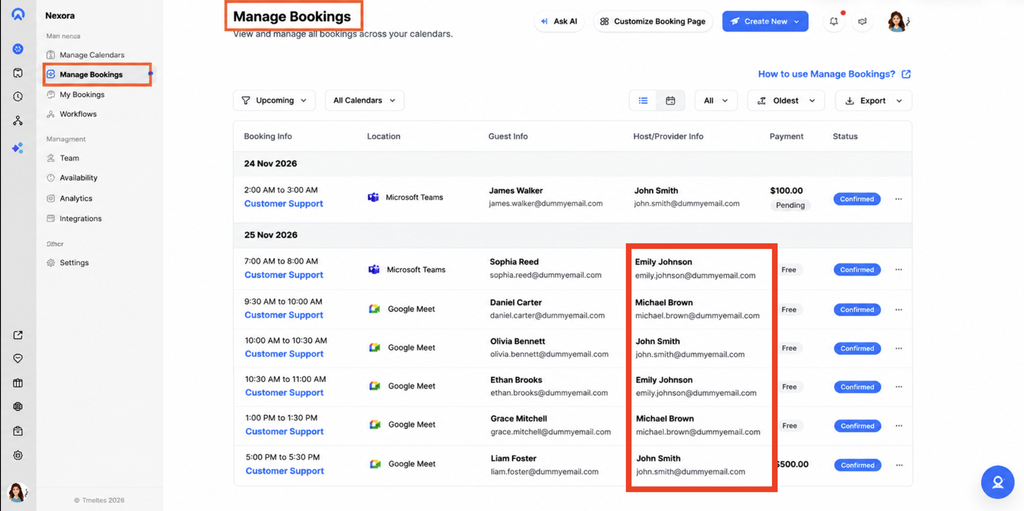
- You’ll find it in your bookings list. Use the calendar type filter and pick Round Robin to see only these bookings, and check the host on each one.
- Recurring bookings stay with one host. The series goes to a host who’s free on every date. If nobody is free for all of them, the guest can’t book the series.
What Happens When a Booking Is Rescheduled
The guest picks a new time from the team’s open times, the same way they booked.
- If their host is free at the new time, the booking stays with the same host.
- If their host is busy at the new time, the booking moves to the next free host in turn.
When a booking moves to a new host:
- The new host gets it as a new booking email, and it’s added to their calendar.
- The old host gets a Booking Moved to Another Host email saying who has it now and that they no longer need to attend.
- The meeting is removed from the old host’s connected calendar.
- The guest’s reschedule confirmation names their new host.
💡 Tip: The same rule applies when you or a host reschedule from the dashboard. If the host is busy at the new time, the booking moves to whoever’s next and free.
Changing Your Hosts Later
You can add or remove hosts at any time from the Team Hosts card.
- New bookings follow the new list. A removed host stops getting bookings, and a new host joins the rotation.
- Existing bookings stay as they are. A removed host keeps any meetings already assigned to them. Reschedule those yourself if they can’t attend.
- Dropping below 2 hosts pauses the calendar. Your booking page stops showing times until you add a second host again.
- People who leave the workspace are removed for you. When a team member leaves, they’re taken off the host list of every calendar.
Automating Messages for Round Robin Bookings
You can send emails or WhatsApp messages only for Round Robin bookings with a workflow. In Workflows, add the Round Robin Booking condition. Leave Calendars empty to match every Round Robin calendar, or pick specific ones.
Host details in your message, like the host name, use the host assigned to that booking.
For example, send a “Meet your host” email to the guest 24 hours before the meeting with the Booking Reminder trigger and the Round Robin Booking condition.
Important Notes
- One host per booking. If you want several team members in the same meeting, use a Many-to-One calendar instead.
- Guests can’t pick their host. The booking page shows your workspace, not individual hosts, and the host is assigned when they book.
- A time stays open while anyone is free. It’s only hidden when every host is busy, including events on their connected calendars.
- Hosts share one set of hours. The calendar’s Availability tab sets the hours for everyone. Hosts’ own bookings and calendars still block them.
- The rotation order is the order you added hosts. A busy host is skipped but keeps their turn.
- You need at least 2 hosts. With fewer, the calendar takes no bookings.
- Hosts must be workspace members. Invite people to your team first, then add them as hosts. Your plan may limit how many hosts you can add.
- Each host uses their own meeting link. Zoom and Google Meet links come from the assigned host’s connected account.
- Duplicating keeps the hosts. When you duplicate a Round Robin calendar, the copy starts with the same host list and its own fresh rotation.
Quick Limits
| Setting | Limit |
|---|---|
| Hosts per calendar | At least 2, including you (the most depends on your plan) |
| Hosts per booking | 1, picked in turn |
| Guests per booking | 1 |
| Rotation order | The order hosts were added |
| Working hours | One shared set, from the calendar’s Availability tab |
| Plan | Needs a plan with team booking |
Frequently Asked Questions
What is a Round Robin calendar?
It’s a team calendar where each booking goes to one team member, picked in turn. Guests book from one page and are matched with the next free host.
Can guests choose which host they get?
No. The host is assigned when the guest books. The booking page shows your workspace, and the guest sees their host’s name on the confirmation.
What happens if it’s someone’s turn but they’re busy?
They’re skipped and the next free host gets the booking. The skipped host keeps their turn and is tried first next time.
Can I change the rotation order?
Hosts take turns in the order you added them. To change the order, remove hosts and add them back in the order you want.
Why doesn’t my booking page show any times?
You may have fewer than 2 hosts, or every host is busy or outside the calendar’s hours at those times.
Do hosts use their own working hours?
No. Everyone follows the hours on this calendar’s Availability tab. Each host’s other bookings and connected calendar events still block them.
Will a rescheduled booking keep the same host?
Yes, if that host is free at the new time. If not, it moves to the next free host, and both hosts and the guest are told.
What happens to booked meetings if I remove a host?
Nothing changes for meetings already booked. They stay with that host. New bookings go to the hosts who are left.
How is this different from Many-to-One?
On a Round Robin calendar, each booking goes to just one team member. On a Many-to-One calendar, every host joins every meeting.
Why can’t I add a team member as a host?
They may not have joined your workspace yet, or you’ve reached the host limit on your plan. Check Team to see if their invite is still pending.
Why am I asked to upgrade when I create a Round Robin calendar?
Round Robin is part of team booking, which isn’t included in your current plan. Upgrade to a plan with team booking to use it.
[SCREENSHOT 13: Upgrade prompt shown when a workspace without team booking tries to create a Round Robin calendar.]
Conclusion
A Round Robin calendar gives your team one booking link and shares the meetings out fairly. Click Create New, choose Round Robin Team Booking, add at least two hosts, set your hours, and share your link. Guests get the times your whole team has open, and each booking lands with the next free person in line.